
Getting an accurate quote for custom silicon steel laminations is not only about sending a part name and asking for a price. For transformer cores, motor cores, reactors, inductors, and other magnetic components, small details in the drawing, material, thickness, stacking method, and performance requirements can change the manufacturing process, tooling cost, lead time, and final unit price.
For sourcing teams, engineers, and OEM buyers, the fastest way to get a reliable quotation is to prepare the right technical information before contacting a supplier. A complete RFQ helps the manufacturer understand the part, check production feasibility, estimate material usage, review tooling needs, and confirm whether additional processes such as annealing, riveting, welding, or electromagnetic testing are required.
This guide explains what buyers should provide when requesting a quote for custom silicon steel laminations, and why each detail matters.
What Are Custom Silicon Steel Laminations?
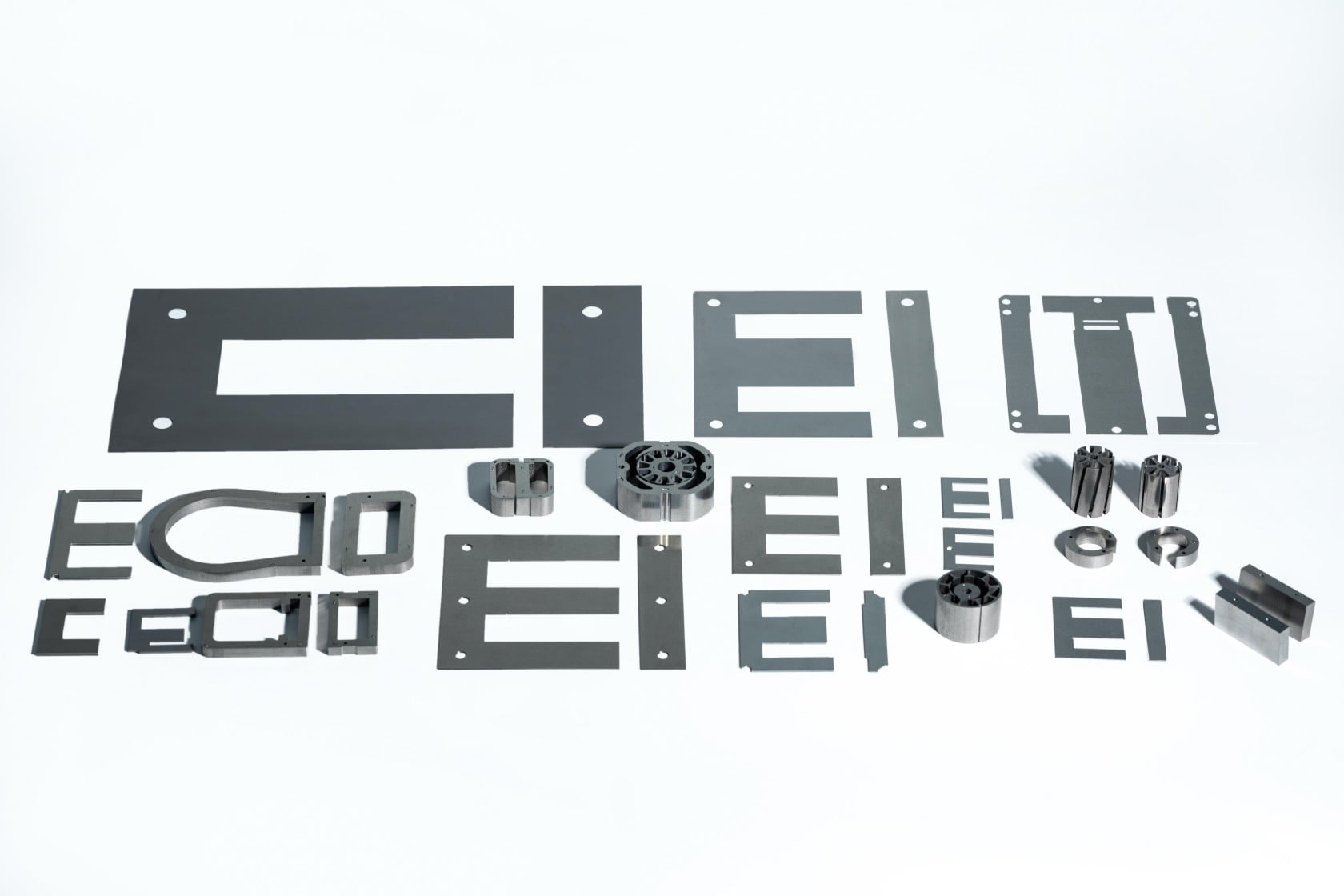
Custom silicon steel laminations are stamped, cut, or processed electrical steel sheets made according to a customer’s drawing or application requirement. They are commonly used to build laminated iron cores for transformers, motors, inductors, reactors, ballasts, and other electromagnetic devices.
Unlike standard EI laminations or UI laminations, custom laminations may require non-standard dimensions, special hole positions, unique slot shapes, special air gaps, custom stack height, or specific magnetic performance requirements.
Common custom lamination types include:
- Laminação EI
- Laminações de interface do usuário
- Three-phase EI laminations
- EI laminations with air gap
- Motor stator laminations
- Motor rotor laminations
- Reactor cores
- Inductor cores
- Núcleos de lastro
- Oblique cut laminations
- Special magnetic cores made from customer drawings
Because custom laminations are often used in OEM products, accuracy and repeatability are important. A supplier must understand both mechanical dimensions and magnetic performance requirements.
Why a Complete RFQ Matters
A complete RFQ saves time for both the buyer and the manufacturer. If important information is missing, the supplier may need several rounds of clarification before providing a quotation. This slows down the project and may lead to inaccurate pricing.
For example, two laminations may look similar in size, but the quotation can be very different if one requires a tighter tolerance, special material grade, low burr control, annealing, or complex tooling.
A complete RFQ can help buyers:
- Get faster quotation feedback
- Reduce misunderstanding
- Avoid wrong material selection
- Estimate tooling cost more accurately
- Confirm sample lead time
- Improve price accuracy
- Reduce production risk
- Improve communication with engineering teams
For custom silicon steel laminations, the best RFQ is not just a purchase request. It is a technical package that allows the supplier to evaluate the part properly.
1. Provide a Clear Drawing
The drawing is the most important document for a custom lamination quote. A good drawing allows the supplier to understand the shape, dimensions, tolerance, hole positions, slot details, air gap design, and stacking requirements.
Preferred drawing formats include:
- DWG
- DXF
- CAD file
- STEP file when applicable
- Physical sample photos for reference
A simple image is usually not enough for accurate manufacturing. Photos can help the supplier understand the part, but they cannot replace a technical drawing.
A proper drawing should include:
| Drawing Detail | Why It Matters |
|---|---|
| Overall dimensions | Confirms part size and material usage |
| Inner window dimensions | Important for transformer and reactor cores |
| Slot shape and hole position | Important for motor stator and rotor cores |
| Posição do espaço de ar | Critical for gapped EI cores and inductors |
| Tolerance | Affects tooling, stamping, and inspection |
| Altura da pilha | Helps estimate total material and assembly process |
| Special notes | Clarifies burr direction, coating, annealing, or packing |
If the drawing is still under development, buyers can send a preliminary version for discussion. The supplier may help review feasibility before final tooling is confirmed.
2. Specify the Material Grade
Silicon steel grade has a direct impact on magnetic performance, core loss, efficiency, and cost. Buyers should specify the required material grade whenever possible.
Common material descriptions may include:
- Aço silício
- Electrical steel
- Non-oriented electrical steel
- Grain-oriented electrical steel
- Specific grade from the buyer’s design
- Equivalent grade accepted by the engineering team
If the exact grade is not known, the buyer should provide the application and performance target. For example, a lamination used in a small appliance motor may have different material needs from a transformer core used in industrial power equipment.
When material grade is unclear, the supplier may offer options, but final approval should come from the buyer’s engineering team.
3. Confirm Lamination Thickness
Thickness is one of the most important parameters for silicon steel laminations. It affects magnetic performance, core loss, stamping difficulty, material cost, and stacking height.
Common thickness options include:
| Grossura | Typical Use |
|---|---|
| 0,23 mm | High-efficiency or low-loss applications |
| 0,27 mm | Precision transformer and motor applications |
| 0,30 mm | General transformer and core applications |
| 0,35 mm | Common industrial transformer and motor cores |
| 0,50 mm | Certain motor, ballast, and industrial applications |
Thinner laminations may help reduce eddy current loss, but they may also increase material cost and stacking complexity. Thicker laminations may be more cost-effective for some applications, but they may not meet low-loss requirements.
Buyers should avoid saying “standard thickness” unless the standard is clearly defined. A better RFQ should state the exact thickness or acceptable range.
4. Share the Application
The same lamination shape can be used in different applications, but the quality requirements may not be the same. A supplier can make better recommendations when the final application is clear.
Useful application details include:
- Transformer type
- Inductor type
- Reactor application
- Motor type
- Appliance product
- Industrial control device
- Power supply equipment
- Ballast application
- Automotive or EV-related component
- Frequency or operating condition when relevant
For example, a core used in a low-noise transformer may need different process control from a core used in a general industrial component. A motor stator lamination may require special attention to slot accuracy and burr direction. A gapped EI core may require careful air gap consistency.
The more the supplier understands the application, the easier it is to review the right process.
5. Define the Quantity
Quantity affects material planning, tooling investment, production method, and unit price. For custom silicon steel laminations, buyers should provide both immediate order quantity and future demand if available.
Useful quantity information includes:
| Quantity Type | Example |
|---|---|
| Sample quantity | 20 sets, 50 pieces, 100 pieces |
| Trial order | 1,000 pieces, 5,000 pieces |
| Mass production order | 50,000 pieces or more |
| Annual forecast | 100,000 pieces per year |
| Project demand | One-time order or repeated supply |
If the project is still in the prototype stage, state that clearly. The supplier can quote sample production separately from mass production.
For high-volume projects, tooling cost and production efficiency become more important. For small batches, the supplier may need to choose a more flexible production method.
6. Specify the Stacking Method
For laminated cores, the stacking method can affect performance, assembly, cost, and production process. Buyers should specify how the laminations will be stacked or whether the supplier needs to provide stacked cores.
Common stacking methods include:
- Loose laminations
- Stacked sets
- Riveted stacking
- Welded stacking
- Interlocked stacking
- Butt stacking
- Custom assembly based on drawing
If the buyer only needs loose laminations, the quotation will be different from a request for fully stacked and assembled cores. If riveting or welding is required, tooling, fixture, labor, and quality inspection must be considered.
For transformer and reactor cores, stacking height and assembly fit are important. For motor stator and rotor cores, alignment and slot consistency are critical.
7. Clarify Burr Requirements
Burr height is often overlooked in RFQs, but it can have a real impact on assembly and performance. Burrs are small raised edges created during stamping or cutting. Excessive burrs can affect stacking quality, insulation, core loss, noise, and assembly efficiency.
Buyers should specify burr requirements when they are critical to the application.
Useful burr-related information includes:
- Maximum burr height
- Burr direction
- Edge quality requirement
- Whether deburring is needed
- Inspection standard
- Special concern for slots, holes, or air gap areas
If the buyer does not have a specific burr requirement, the supplier can follow its internal quality standard. However, for precision transformer cores, motor cores, or low-loss applications, burr control should be discussed before production.
8. Confirm Whether Annealing Is Required
Annealing is a controlled heat treatment process used to reduce internal stress and improve magnetic stability. It may help reduce stress-related core loss and improve batch consistency.
Not every custom lamination requires annealing, but it can be important for applications where magnetic performance matters.
Annealing may be considered for:
- Low-loss transformer cores
- Precision EI laminations
- UI laminations used in reactors
- Gapped EI cores
- Three-phase EI cores
- Custom silicon steel cores
- Applications sensitive to noise or heat rise
When sending an RFQ, buyers should clearly state whether annealing is required, optional, or open for supplier recommendation.
If the buyer has a target core loss, noise requirement, or magnetic performance data, that information should be shared early.
9. Provide Performance Requirements
A lamination is not only a metal part. It is part of a magnetic system. For some projects, dimensions alone are not enough. Performance targets can affect material selection, annealing, stacking, testing, and final quality control.
Useful performance requirements include:
| Requirement | Why It Matters |
|---|---|
| Perda central | Helps select material and process |
| Inductance | Important for inductors and reactors |
| Nível de ruído | Important for low-noise transformers |
| Aumento de calor | Related to efficiency and loss |
| Magnetic permeability | Important for performance stability |
| Frequência de operação | Affects core design and material selection |
| Current or power rating | Helps understand final application |
If performance data is not available, buyers should at least share the product application and operating environment.
10. Share Packaging and Export Requirements
Packaging is important for silicon steel laminations because thin sheets and stacked cores can be damaged during transportation. Deformation, rust, moisture exposure, or poor packing can create problems during assembly.
Buyers should specify packing requirements when needed.
Common packaging details include:
- Carton packing
- Wooden pallet
- Moisture protection
- Anti-rust protection
- Layer separation
- Labeling requirement
- Batch number marking
- Export shipping requirement
- Special handling instructions
For international buyers, export-ready packaging should be discussed before shipment, especially for heavy cores, thin laminations, or precision parts.
RFQ Checklist for Custom Silicon Steel Laminations
Before requesting a quote, buyers can use the following checklist:
| Item da RFQ | Informações recomendadas |
|---|---|
| Desenho | PDF, DWG, DXF, CAD ou amostra |
| Tipo de produto | EI, UI, motor core, reactor core, custom core |
| Grau do material | Aço silício / aço elétrico |
| Grossura | 0.23mm, 0.27mm, 0.30mm, 0.35mm, 0.50mm or custom |
| Quantidade | Amostra, pedido experimental, produção em massa, previsão anual |
| Aplicativo | Transformer, motor, inductor, reactor, ballast, appliance |
| Tolerance | Key dimensions and fit requirements |
| Requisito de rebarba | altura máxima da rebarba ou expectativa de qualidade da borda |
| Método de empilhamento | Loose, riveted, welded, stacked, or custom |
| Recozimento | Obrigatório, não obrigatório ou recomendação do fornecedor |
| Performance Target | Core loss, noise, inductance, heat rise |
| Testando | Dimensional, magnetic, or customer-specific testing |
| Embalagem | Carton, pallet, anti-rust, moisture protection |
A complete checklist helps both sides move faster and reduces the risk of incorrect assumptions.
Common RFQ Mistakes to Avoid
Many quotation delays happen because the RFQ is incomplete. Here are common mistakes buyers should avoid.
1. Sending Only a Product Name
A request such as “Please quote EI core” is usually not enough. EI cores come in many sizes, materials, thicknesses, and stacking requirements.
2. Using Photos Instead of Drawings
Photos are useful for reference, but they cannot confirm exact dimensions, tolerances, or manufacturing requirements.
3. Not Mentioning Material Grade
Material grade affects both price and performance. If the grade is unknown, buyers should provide the application and expected performance.
4. Ignoring Thickness
Thickness affects magnetic performance and cost. It should always be specified or discussed.
5. Not Defining Quantity
Sample price and mass production price can be very different. Suppliers need quantity information to quote properly.
6. Leaving Out Annealing Requirements
If annealing is needed but not mentioned, the quotation may be incomplete or incorrect.
7. Not Discussing Burr Control
Burr control can affect stacking, insulation, core loss, and assembly quality. It should be discussed for precision applications.
How to Choose a Supplier for Custom Silicon Steel Laminations
A reliable supplier should be able to do more than produce a stamped shape. For custom silicon steel laminations, the supplier should understand material behavior, stamping quality, burr control, annealing, stacking, and magnetic performance.
As principais competências dos fornecedores incluem:
- Experiência com lâminas de aço silício
- Drawing-based OEM manufacturing
- Capacidade de estampagem de precisão
- Rastreabilidade de materiais
- Processo de controle de rebarbas
- Capacidade de recozimento
- Stacking and assembly options
- Inspeção dimensional
- Testes de desempenho eletromagnético
- Export packaging experience
- Stable batch production
- Comunicação clara em engenharia
For buyers, the best supplier is not always the one with the lowest unit price. A strong supplier should help reduce risk from sample development to mass production.
Produtos relacionados
For custom silicon steel lamination projects, buyers may also review these product categories:
- Laminação EI
- Laminação EI com espaço de ar
- Laminação da interface do usuário
- Laminação EI trifásica
- Núcleo do motor
- Laminação por recozimento
- Rebitagem empilhada
- Laminação com corte oblíquo
- Núcleo de lastro
- Lâminas de aço silício fabricadas sob medida
Perguntas frequentes
1. What information is needed for a custom silicon steel lamination quote?
Buyers should provide drawings, material grade, thickness, quantity, application, tolerance, stacking method, burr requirement, annealing requirement, performance target, and packing requirement.
2. Can custom silicon steel laminations be made from drawings?
Yes. Custom silicon steel laminations are commonly produced based on PDF, DWG, DXF, CAD drawings, or physical samples. A clear drawing helps the supplier review feasibility and quote accurately.
3. What thickness is commonly used for silicon steel laminations?
Common thickness options include 0.23mm, 0.27mm, 0.30mm, 0.35mm, and 0.50mm. The right thickness depends on application, core loss requirement, cost target, and design needs.
4. Is annealing required for custom laminations?
Annealing is not always required. It may be recommended when the project needs better magnetic stability, lower stress-related core loss, or improved batch consistency.
5. Why is burr control important?
Burr control affects stacking quality, insulation reliability, core loss, noise, and assembly efficiency. For precision transformer cores and motor cores, burr requirements should be discussed before production.
6. Do I need tooling for custom silicon steel laminations?
Many custom laminations require tooling, especially for repeated production or complex shapes. For prototypes or small batches, the supplier may review whether alternative processing methods are possible.
7. Can samples be made before mass production?
Yes. For OEM projects, sample production is recommended before mass production. Samples allow the buyer to check dimensions, assembly fit, magnetic performance, and packaging before confirming larger orders.
8. What affects the price of custom silicon steel laminations?
The price is affected by material grade, thickness, part size, shape complexity, tolerance, tooling, quantity, stacking method, annealing, testing, packaging, and delivery requirements.

An accurate quotation for custom silicon steel laminations depends on clear technical information. Buyers should provide drawings, material grade, thickness, quantity, application, tolerance, burr requirement, stacking method, annealing requirement, performance target, and packing details.
A complete RFQ helps the supplier understand the part, reduce assumptions, confirm manufacturing feasibility, and provide a more reliable price. It also helps buyers avoid delays, quality risks, and unexpected production costs.
For transformer cores, motor cores, reactors, inductors, ballasts, and custom magnetic components, the right supplier should combine stamping capability, material knowledge, burr control, annealing experience, testing support, and export packaging.
Need a quote for custom silicon steel laminations? Send your drawing, material grade, thickness, quantity, application, stacking method, and performance requirements. Our team will review your project and provide a quotation.