
Introduction: Why Core Laminations Matter for Transformer Performance
In today’s competitive transformer-component market, the quality, precision, and engineering of the core laminations play a vital role in achieving high-efficiency, reliable, and cost-effective transformer solutions. As a dedicated supplier of EI transformer cores, Tianxiang understands that the heart of any transformer’s magnetic circuit is composed of stacked sheets of electrical steel — the core laminations — which determine losses, noise, thermal behavior, and overall operational lifetime. By focusing on premium materials, optimized stacking of core laminations, and excellent supply chain execution, we help our B2B customers access transformer core assemblies that maximize performance and minimize risk.
Section 1: Fundamentals of Core Laminations
What Are Core Laminations?
Simply put, core laminations refer to thin, insulated sheets of ferromagnetic material, typically silicon steel, which are stacked or bonded together to form a magnetic core in a transformer. Unlike a solid metal core, the use of individual lamination sheets interrupts eddy currents and reduces core losses substantially. In essence, the core laminations are the building blocks of the transformer core.
Dealers and OEMs in the transformer industry evaluate factors such as lamination thickness, material grade, insulation coating, stamping precision, stacking method, and joint technique — all of which affect how the core laminations perform in the final product.
Why Use Core Laminations Instead of Solid Cores?
Solid cores may seem simpler, but they suffer from high eddy-current losses and heat generation. In contrast, well-designed core laminations confine eddy currents to the thin sheets and limit losses, ensuring higher efficiency and lower operating temperature. Therefore, for transformer manufacturers who source EI cores, ensuring high-quality core laminations is the first step toward creating low-loss, high-reliability products.
Key Performance Metrics for Core Laminations
When evaluating core laminations, several parameters determine performance:
- Lamination thickness: Thinner sheets reduce eddy-current paths, lowering losses.
- Material grade and orientation: Grain-oriented or non-grain-oriented silicon steel provides specific magnetic advantages.
- Stacking factor: The ratio of active steel to total core cross-section; higher factors indicate denser stacking.
- Joint design and stacking method: How lamination sheets are arranged (E-I shape, step lap, or mitered) affects flux leakage and losses.
- Insulation integrity: Each lamination must be properly insulated to prevent circulating currents between sheets.
By controlling these metrics, suppliers like Tianxiang deliver EI cores with optimized core laminations tailored for efficiency and longevity.
Section 2: The Role of EI Transformer Cores in B2B Applications
What Is an EI Core and Why It Relies on Core Laminations
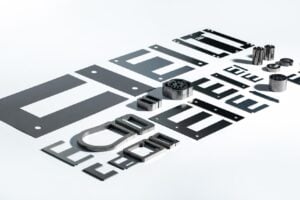
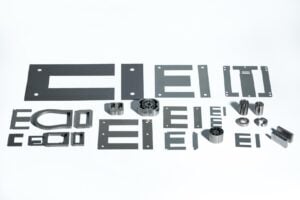
An EI core is constructed from E-shaped and I-shaped lamination stampings fitted together to form the magnetic path. Each E and I component is composed of stacked core laminations. For our B2B customers, EI cores offer modularity, ease of assembly, and reliable performance.
When a manufacturer orders EI cores, they are essentially purchasing a carefully engineered stack of core laminations pressed, aligned, and assembled into precise geometries — ready for winding and integration.
Why B2B Customers Choose Quality Core Laminations for EI Cores
For OEMs, contract manufacturers, and industries such as renewable energy, utilities, and automation, premium core laminations offer multiple benefits:
- Reduced iron losses for higher efficiency.
- Lower noise and vibration through uniform stacking.
- Better thermal performance and longer service life.
- Scalable supply chain for consistent production.
- Customization options for size, thickness, and coating.
At Tianxiang, we specialize in EI transformer cores made from high-grade core laminations, understanding that true performance begins at the lamination sheet level.
Section 3: Key Design & Engineering Considerations for Core Laminations
Selecting the Right Material for Core Laminations
Choosing the correct grade of electrical steel for core laminations is critical. It determines magnetic permeability, resistivity, and thermal stability. Grain-oriented steels provide excellent magnetic directionality, while non-oriented steels allow versatility for different core shapes.
At the lamination level, Tianxiang ensures tight tolerances in thickness, uniform coating, minimal burrs, and consistent mechanical strength to guarantee the highest performance.
Lamination Thickness & Its Impact
One of the most significant parameters for core laminations is thickness. Eddy-current losses increase with the square of thickness and frequency, so using thinner and well-insulated lamination sheets dramatically improves transformer performance.
Joint Design, Stacking, and Assembly
The way core laminations are stacked and joined in EI core geometry impacts efficiency and mechanical stability. Techniques such as alternate stacking, step-lap, or miter joints minimize air gaps and reduce flux leakage. Proper clamping ensures mechanical rigidity without shorting between lamination sheets.
At Tianxiang, every EI core assembly is built with strict control over edge quality, alignment, and joint precision, ensuring each stack of core laminations performs consistently under real operating conditions.
Thermal and Mechanical Durability
Transformers experience magnetostriction, vibration, and thermal expansion during operation. High-quality core laminations resist deformation, delamination, and loss of clamping force. Proper insulation and bonding between layers prevent shorts and heat buildup, ensuring long-term stability.
Section 4: Manufacturing Excellence in Core Laminations
Precision Stamping and Finishing
The manufacturing of core laminations begins with precision stamping or laser-cutting of lamination sheets. Dimensional accuracy, clean edges, and coating consistency are essential. Tianxiang employs advanced stamping technologies to ensure minimal burrs, tight tolerances, and high repeatability — delivering lamination stacks ready for efficient core assembly.
Insulation and Coating
Insulation between lamination sheets prevents inter-lamination currents and ensures long-term stability under heat. Tianxiang applies high-quality coatings and varnishes that maintain insulation integrity, even under thermal cycling and vibration.
Quality Control and Testing
Every batch of core laminations undergoes thorough inspection for material grade, dimensional accuracy, coating uniformity, and assembly performance. Tests include measurements of core loss, stacking factor, and mechanical integrity. These rigorous checks guarantee reliable performance for every EI core we produce.
Lead Time and Supply Chain Management
Reliable supply of core laminations is vital for B2B transformer manufacturers. Tianxiang maintains scalable production capacity, consistent material sourcing, and dependable logistics to ensure timely delivery, even in high-demand conditions.
Section 5: Application Areas and Industry Trends
Growing Demand Across Sectors
The use of core laminations spans multiple industries:
- Utility transformers for efficient power distribution
- EV charging systems requiring compact, high-efficiency cores
- Renewable energy transformers for wind and solar applications
- Industrial drives and automation systems where reliability and efficiency are key
Each sector depends on precise engineering of core laminations to meet performance and efficiency goals.
Efficiency and Sustainability
As global efficiency standards tighten, the design of core laminations directly affects compliance. Lower core losses reduce energy waste and operational costs. Manufacturers adopting advanced lamination technologies not only improve performance but also contribute to sustainability and environmental goals.
Customization and Innovation
Many customers require customized lamination designs — special coatings, unique geometries, or tailored materials for frequency-specific applications. Tianxiang provides flexible lamination engineering, ensuring each client receives core laminations suited to their specific design and performance targets.
Section 6: Why Choose Tianxiang for Your Core Laminations and EI Transformer Cores
Deep Expertise
Tianxiang specializes in manufacturing and supplying EI transformer cores built from high-quality core laminations. Our expertise spans material selection, precision stamping, stacking, joint design, and finishing. We combine engineering precision with practical manufacturing knowledge to deliver superior cores that meet stringent industry standards.
Quality and Reliability
Quality control is at the heart of our production process. Every step — from incoming material inspection to final packaging — ensures that the core laminations meet the required specifications. Our customers benefit from consistent product performance and reduced downtime.
Tailored Solutions
We understand that every customer’s needs are unique. Whether you require standard EI core sizes or custom lamination assemblies, Tianxiang offers flexible, scalable solutions. Options include various steel grades, lamination thicknesses, coating types, and stacking configurations to match your transformer application perfectly.
Section 7: Practical Advice for B2B Buyers
Specifying Core Laminations for Your Project
When preparing an order or RFQ, consider these details:
- Lamination material grade and thickness
- Coating type and insulation requirements
- Dimensional tolerances and stacking factor
- Preferred joint design (step-lap, miter, or butt)
- Testing and documentation needs (core loss, insulation resistance)
- Lead time and logistics expectations
By specifying these clearly, you ensure that your supplier provides core laminations that meet both technical and commercial requirements.
Evaluating Supplier Performance
A reliable core laminations supplier demonstrates consistency, transparency, and technical support. Tianxiang maintains these standards, providing quality certificates, test data, and batch traceability to give clients complete confidence.
Cost-Benefit Perspective
Investing in high-quality core laminations yields long-term savings. Lower losses mean reduced power consumption, less heat generation, and extended transformer life. In addition, precise lamination design can reduce core size and overall material cost — delivering a clear advantage in competitive markets.
Section 8: Frequently Asked Questions
Q1: How do I choose the right lamination thickness?
Thinner core laminations reduce eddy-current losses, especially at higher frequencies, though cost and manufacturing complexity increase. Tianxiang helps you select the ideal thickness based on your transformer specifications.
Q2: What is the stacking factor?
The stacking factor measures how efficiently laminations fill the magnetic cross-section. Higher stacking factors indicate tighter, more effective assembly of core laminations.
Q3: Why are lamination joints important?
Improper joints can increase magnetic reluctance and losses. Tianxiang uses optimized step-lap and miter joints to maintain smooth flux paths and minimize inefficiencies.
Q4: Can laminations from different batches be mixed?
Mixing materials is not recommended, as inconsistencies can affect performance and reliability. Tianxiang provides full traceability for each batch of core laminations to maintain quality control.
Q5: Are laminated cores suitable for higher-frequency applications?
Yes, but thinner and better-insulated core laminations are required. For very high frequencies, alternative materials such as ferrite may be considered.
Conclusion
The foundation of every efficient and reliable transformer lies in the quality of its core laminations. From material selection and precision stamping to insulation, stacking, and finishing, every detail affects performance and longevity.
Tianxiang is committed to delivering premium EI transformer cores built from superior core laminations that enhance energy efficiency, reduce operational costs, and meet global standards. With advanced manufacturing, strict quality control, and responsive B2B service, we are your trusted partner in transformer core solutions.
Partner with Tianxiang today — and build better transformers from the core up.